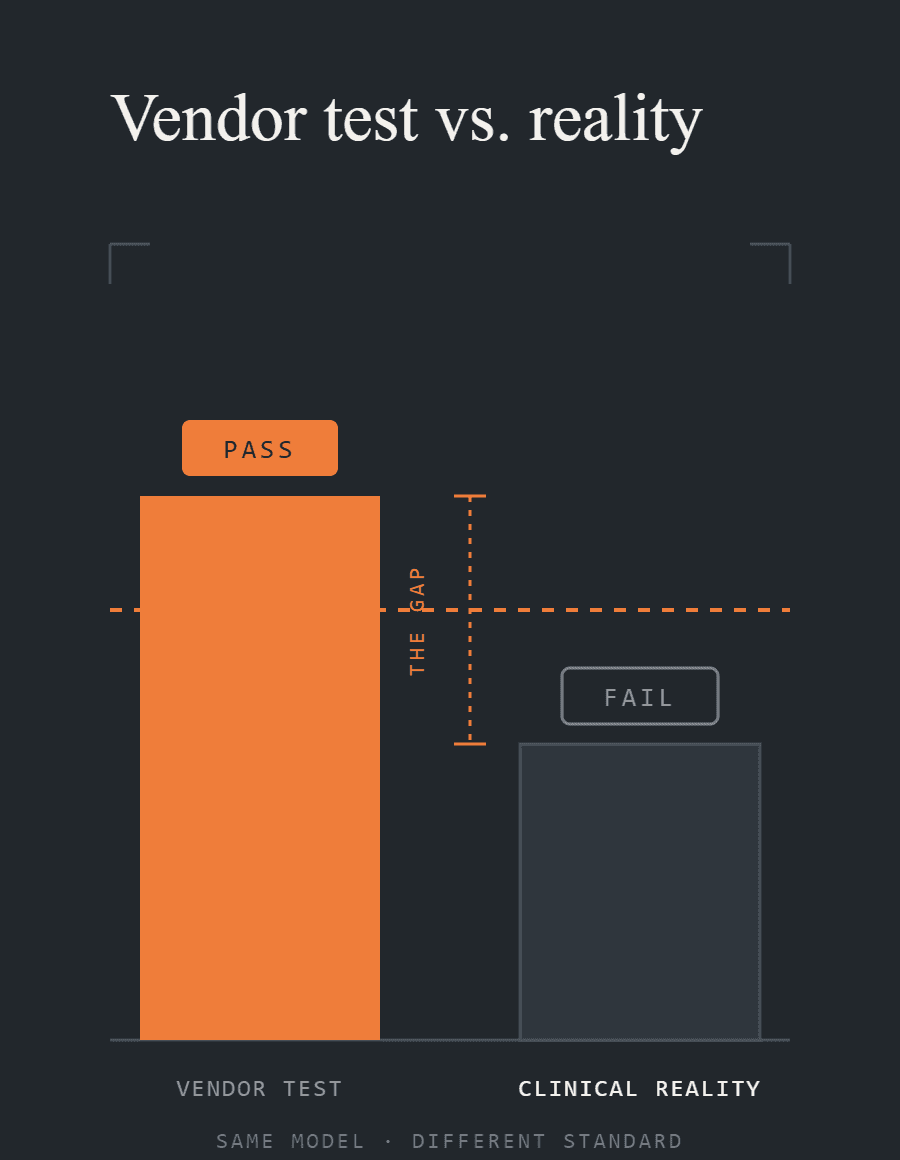
Your AI Passed Vendor Tests. Will It Pass Clinical Reality?
Healthcare can't afford to deploy AI on vendor claims and limited testing. We implement comprehensive evaluation frameworks that measure clinical validity, audit for bias, test failure modes, and monitor real-world performance against the standards required in clinical environments.

Why "It Works" Isn't Good Enough
The Real Problem with
Healthcare AI
Most organizations deploy AI based on vendor accuracy claims or internal testing on clean datasets.
This approach might work for consumer applications where failures are inconvenient. In healthcare, inadequate evaluation creates patient safety risks, regulatory exposure, malpractice liability, and trust erosion that can derail entire AI programs.
The stakes are different in healthcare.
The FDA is increasing oversight of clinical AI. Poorly validated systems face regulatory action and potential market withdrawal. One publicized failure can destroy provider and patient confidence across your entire organization, undermining years of investment.
Healthcare AI requires evaluation standards that match the stakes.
What Comprehensive Evaluation Actually Means
What AI-Ready Data
Actually Looks Like
What AI-Ready Data Actually
Looks Like
Healthcare AI evaluation goes far beyond simple accuracy metrics. It requires:
Clinical validity testing against physician performance on standardized cases
Bias and fairness audits across demographic groups to prevent healthcare disparities
Adversarial testing to find failure modes and edge cases
Regulatory compliance documentation meeting FDA guidance
Continuous real-world monitoring with outcome correlation and drift detection
Most organizations lack the frameworks and expertise to conduct this level of evaluation.
We build and implement these systems as an engineering discipline, not an afterthought.
Five Risks You Can't Afford
Patient Safety
The risk: AI errors in clinical settings can lead to misdiagnosis, incorrect treatments, or missed critical findings, potentially putting lives at risk.
How we address it: Rigorous pre-deployment testing that identifies failure modes before clinical use. Edge case testing on rare conditions. Adversarial inputs designed to break the system safely in testing rather than dangerously in production.
Regulatory Exposure
The risk: FDA oversight of clinical AI is increasing. Poorly validated systems face regulatory action and potential market withdrawal.
How we address it: Evaluation frameworks following FDA guidance on clinical decision support systems. Documentation that demonstrates due diligence and systematic validation aligned with regulatory expectations.
Trust Erosion
The risk: One publicized AI failure can destroy provider and patient confidence in your entire AI program, undermining years of investment.
How we address it: Systematic evaluation that prevents the failures creating headlines. Clinical validity testing ensuring AI recommendations align with evidence-based guidelines before deployment.
Liability Exposure
The risk: Malpractice and HIPAA violation risks from AI systems making incorrect decisions create significant legal and financial exposure.
How we address it: Documented evaluation providing evidence of due diligence. Audit trails showing systematic testing across diverse scenarios. Compliance documentation suitable for legal review.
Hidden Bias
The risk: AI systems can perpetuate or amplify healthcare disparities if not rigorously evaluated across diverse patient populations.
How we address it: Bias audits measuring performance across race, ethnicity, age, sex, gender, geographic regions, and socioeconomic indicators. Issues identified and addressed before deployment.
Patient Safety
The risk: AI errors in clinical settings can lead to misdiagnosis, incorrect treatments, or missed critical findings, potentially putting lives at risk.
How we address it: Rigorous pre-deployment testing that identifies failure modes before clinical use. Edge case testing on rare conditions. Adversarial inputs designed to break the system safely in testing rather than dangerously in production.
Regulatory Exposure
The risk: FDA oversight of clinical AI is increasing. Poorly validated systems face regulatory action and potential market withdrawal.
How we address it: Evaluation frameworks following FDA guidance on clinical decision support systems. Documentation that demonstrates due diligence and systematic validation aligned with regulatory expectations.
Trust Erosion
The risk: One publicized AI failure can destroy provider and patient confidence in your entire AI program, undermining years of investment.
How we address it: Systematic evaluation that prevents the failures creating headlines. Clinical validity testing ensuring AI recommendations align with evidence-based guidelines before deployment.
Liability Exposure
The risk: Malpractice and HIPAA violation risks from AI systems making incorrect decisions create significant legal and financial exposure.
How we address it: Documented evaluation providing evidence of due diligence. Audit trails showing systematic testing across diverse scenarios. Compliance documentation suitable for legal review.
Hidden Bias
The risk: AI systems can perpetuate or amplify healthcare disparities if not rigorously evaluated across diverse patient populations.
How we address it: Bias audits measuring performance across race, ethnicity, age, sex, gender, geographic regions, and socioeconomic indicators. Issues identified and addressed before deployment.
Our Evaluation Framework
01.
Pre-Deployment Testing
What we test:
Edge cases for rare conditions and atypical presentations
Adversarial inputs designed to find failure modes
Performance across demographic groups to identify bias
Comparison against clinician performance on standardized test sets
Our standard:
We don't declare a system ready for clinical use until it passes defined performance thresholds across all evaluation dimensions.
Why this matters:
Catching failures in controlled testing rather than clinical production.
01.
Pre-Deployment Testing
What we test:
Edge cases for rare conditions and atypical presentations
Adversarial inputs designed to find failure modes
Performance across demographic groups to identify bias
Comparison against clinician performance on standardized test sets
Our standard:
We don't declare a system ready for clinical use until it passes defined performance thresholds across all evaluation dimensions.
Why this matters:
Catching failures in controlled testing rather than clinical production.
01.
Pre-Deployment Testing
What we test:
Edge cases for rare conditions and atypical presentations
Adversarial inputs designed to find failure modes
Performance across demographic groups to identify bias
Comparison against clinician performance on standardized test sets
Our standard:
We don't declare a system ready for clinical use until it passes defined performance thresholds across all evaluation dimensions.
Why this matters:
Catching failures in controlled testing rather than clinical production.
02.
Clinical Validity Assessment
Comparison against clinician performance with rigorous metrics.
Beyond simple accuracy:
Performance on critical conditions where false negatives have serious consequences
Alignment with evidence-based clinical guidelines
Appropriate confidence levels that support rather than override clinical judgment
Sensitivity, specificity, and ROC curve analysis
The question we answer:
Does this AI perform as well as or better than human clinicians on the same cases?
02.
Clinical Validity Assessment
Comparison against clinician performance with rigorous metrics.
Beyond simple accuracy:
Performance on critical conditions where false negatives have serious consequences
Alignment with evidence-based clinical guidelines
Appropriate confidence levels that support rather than override clinical judgment
Sensitivity, specificity, and ROC curve analysis
The question we answer:
Does this AI perform as well as or better than human clinicians on the same cases?
02.
Clinical Validity Assessment
Comparison against clinician performance with rigorous metrics.
Beyond simple accuracy:
Performance on critical conditions where false negatives have serious consequences
Alignment with evidence-based clinical guidelines
Appropriate confidence levels that support rather than override clinical judgment
Sensitivity, specificity, and ROC curve analysis
The question we answer:
Does this AI perform as well as or better than human clinicians on the same cases?
03.
Bias and Fairness Audits
We evaluate across:
Race and ethnicity
Age groups
Sex and gender
Geographic regions
Socioeconomic indicators
The goal:
Ensuring AI performs equitably across all patient populations and doesn't perpetuate existing healthcare disparities.
Why this is non-negotiable:
Healthcare disparities are already a crisis. AI that amplifies them creates both ethical failures and legal liability.
03.
Bias and Fairness Audits
We evaluate across:
Race and ethnicity
Age groups
Sex and gender
Geographic regions
Socioeconomic indicators
The goal:
Ensuring AI performs equitably across all patient populations and doesn't perpetuate existing healthcare disparities.
Why this is non-negotiable:
Healthcare disparities are already a crisis. AI that amplifies them creates both ethical failures and legal liability.
03.
Bias and Fairness Audits
We evaluate across:
Race and ethnicity
Age groups
Sex and gender
Geographic regions
Socioeconomic indicators
The goal:
Ensuring AI performs equitably across all patient populations and doesn't perpetuate existing healthcare disparities.
Why this is non-negotiable:
Healthcare disparities are already a crisis. AI that amplifies them creates both ethical failures and legal liability.
04.
Real-World Monitoring
Continuous tracking after deployment with outcome correlation.
What we monitor:
Clinician agreement rates with AI recommendations
Patient outcomes compared to AI predictions
Performance drift as patient populations and clinical practices change
Edge cases and failure modes emerging in production
Feedback loops where human corrections improve the system
The reality:
AI performance in production often differs from performance in testing. Continuous monitoring catches degradation before it affects patient care.
04.
Real-World Monitoring
Continuous tracking after deployment with outcome correlation.
What we monitor:
Clinician agreement rates with AI recommendations
Patient outcomes compared to AI predictions
Performance drift as patient populations and clinical practices change
Edge cases and failure modes emerging in production
Feedback loops where human corrections improve the system
The reality:
AI performance in production often differs from performance in testing. Continuous monitoring catches degradation before it affects patient care.
04.
Real-World Monitoring
Continuous tracking after deployment with outcome correlation.
What we monitor:
Clinician agreement rates with AI recommendations
Patient outcomes compared to AI predictions
Performance drift as patient populations and clinical practices change
Edge cases and failure modes emerging in production
Feedback loops where human corrections improve the system
The reality:
AI performance in production often differs from performance in testing. Continuous monitoring catches degradation before it affects patient care.
How We Implement Evaluation


01
Framework Design (Weeks 1-2)
We establish custom evaluation criteria based on your specific use cases and risk tolerance.
What happens:
Test dataset creation with diverse patient populations
Clinician ground truth labeling protocols
Bias assessment methodology specific to your patient demographics
Regulatory compliance requirements based on your use cases and jurisdiction
What you get:
Clear evaluation criteria aligned with clinical standards and regulatory expectations.
Framework Design (Weeks 1-2)
We establish custom evaluation criteria based on your specific use cases and risk tolerance.
What happens:
Test dataset creation with diverse patient populations
Clinician ground truth labeling protocols
Bias assessment methodology specific to your patient demographics
Regulatory compliance requirements based on your use cases and jurisdiction
What you get:
Clear evaluation criteria aligned with clinical standards and regulatory expectations.
Framework Design (Weeks 1-2)
We establish custom evaluation criteria based on your specific use cases and risk tolerance.
What happens:
Test dataset creation with diverse patient populations
Clinician ground truth labeling protocols
Bias assessment methodology specific to your patient demographics
Regulatory compliance requirements based on your use cases and jurisdiction
What you get:
Clear evaluation criteria aligned with clinical standards and regulatory expectations.
Comprehensive Testing (Weeks 3-8)
Pre-deployment validation against established criteria.
Core testing:
Clinical accuracy assessment comparing AI to physician benchmarks
Demographic bias analysis across patient populations
Edge case testing for rare and atypical scenarios
Regulatory compliance documentation preparing for potential FDA or state oversight
Delivered continuously:
Testing results and refinements every 1-2 weeks, not a final report at the end.
Comprehensive Testing (Weeks 3-8)
Pre-deployment validation against established criteria.
Core testing:
Clinical accuracy assessment comparing AI to physician benchmarks
Demographic bias analysis across patient populations
Edge case testing for rare and atypical scenarios
Regulatory compliance documentation preparing for potential FDA or state oversight
Delivered continuously:
Testing results and refinements every 1-2 weeks, not a final report at the end.
Comprehensive Testing (Weeks 3-8)
Pre-deployment validation against established criteria.
Core testing:
Clinical accuracy assessment comparing AI to physician benchmarks
Demographic bias analysis across patient populations
Edge case testing for rare and atypical scenarios
Regulatory compliance documentation preparing for potential FDA or state oversight
Delivered continuously:
Testing results and refinements every 1-2 weeks, not a final report at the end.
02


03
Continuous Monitoring (Weeks 9-12 and ongoing)
Production deployment with real-time performance tracking.
What runs continuously:
Dashboards showing real-world AI performance
Automated drift detection alerting when performance degrades
Human-AI disagreement tracking identifying where clinicians override recommendations and why
Adverse event monitoring flagging potential safety issues
Regular re-evaluation protocols ensuring sustained performance
What you get:
Visibility into AI performance with automated alerts before issues affect patient care.
Continuous Monitoring (Weeks 9-12 and ongoing)
Production deployment with real-time performance tracking.
What runs continuously:
Dashboards showing real-world AI performance
Automated drift detection alerting when performance degrades
Human-AI disagreement tracking identifying where clinicians override recommendations and why
Adverse event monitoring flagging potential safety issues
Regular re-evaluation protocols ensuring sustained performance
What you get:
Visibility into AI performance with automated alerts before issues affect patient care.
Continuous Monitoring (Weeks 9-12 and ongoing)
Production deployment with real-time performance tracking.
What runs continuously:
Dashboards showing real-world AI performance
Automated drift detection alerting when performance degrades
Human-AI disagreement tracking identifying where clinicians override recommendations and why
Adverse event monitoring flagging potential safety issues
Regular re-evaluation protocols ensuring sustained performance
What you get:
Visibility into AI performance with automated alerts before issues affect patient care.
Standards We Follow
Technology Partnerships That Reduce Risk
Standards We Follow
We don't create custom evaluation standards. We implement the frameworks that regulators and clinical leadership recognize and trust.
What You Actually Receive
When Evaluation Becomes Critical
You need comprehensive AI evaluation if you're:
Deploying systems that influence clinical decisions, diagnoses, or treatment recommendations.
Facing questions from clinical leadership about AI safety, reliability, and trustworthiness.
Preparing for regulatory review, compliance audits, or FDA oversight.
Expanding AI applications to new patient populations, clinical settings, or higher-risk use cases.
Responding to provider concerns about AI accuracy, bias, or inappropriate recommendations.
You need comprehensive AI evaluation if you're:
Deploying systems that influence clinical decisions, diagnoses, or treatment recommendations.
Facing questions from clinical leadership about AI safety, reliability, and trustworthiness.
Preparing for regulatory review, compliance audits, or FDA oversight.
Expanding AI applications to new patient populations, clinical settings, or higher-risk use cases.
Responding to provider concerns about AI accuracy, bias, or inappropriate recommendations.
If you're deploying AI without systematic evaluation, you're accepting risks that are both preventable and potentially catastrophic.
Common Questions
Common
Questions
How much does comprehensive evaluation cost compared to the AI system itself?
Can't our AI vendor handle evaluation?
When should we start evaluation?
What if we've already deployed AI without systematic evaluation?
How do we know if our evaluation is sufficient?
How much does comprehensive evaluation cost compared to the AI system itself?
Can't our AI vendor handle evaluation?
When should we start evaluation?
What if we've already deployed AI without systematic evaluation?
How do we know if our evaluation is sufficient?
How much does comprehensive evaluation cost compared to the AI system itself?
Can't our AI vendor handle evaluation?
When should we start evaluation?
What if we've already deployed AI without systematic evaluation?
How do we know if our evaluation is sufficient?